|
Factors Governing the design of welder open circuit voltage reducing devices primary and secondary welder strike.
What is an open circuit voltage reducer?
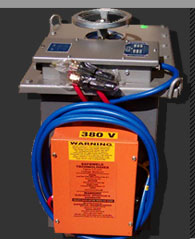
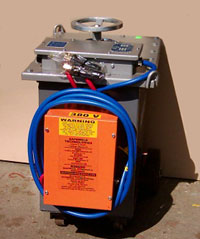
The open circuit voltage reducing device hear after ( Safeweld unit) reducers the voltage between the electrode and the earth clamp to the permissible voltage of 32 volts and
below ( Safeweld as low as 9 volts dependent on the type of welding machine) as required by the mines and works act. The Safeweld unit will not activate the welding machine unless the resistance between the electrode and the earth clamp is between
0 and 3.5 ohms any higher than 3.5 ohms will not allow the welding machine to operate. In other words the human body resistance can not cause the welding machine to
activate. There must be a positive contact between the electrode and the work piece/ earth to cause the welding machine to operate.
|
|
Detection
Detection of welder strike current on AC welders can be achieved by the injection of a
lower voltage into either the primary or the secondary welder circuit, in the case of AC welders with low magnetizing current primary injection of a voltage which will produce a voltage
plus or minus 19 volts in the secondary of the welder. Certain welders will have high no-load currents (magnetizing current) when full voltage is applied. It is therefore important
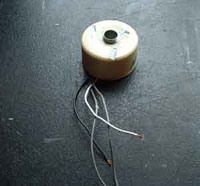
to have both primary and secondary current detection. The reason for this, is that the magnetizing current can nearly equal full load primary welding current particularly when the supply voltage rises above standard voltage. AC/DC welders or welders that have a high magnetizing current, must use secondary low voltage injection to comply with regulations . The injection winding of the control transformer must have a earth screen.
|
|
Welder Magnetizing Current
Magnetizing current is determined by the grade of transformer steel as well as the
design
of the welder. It is also affected by the variation of the supply voltage to the welder. If the designed voltage is 525 volts and the designed flux density is too close to the knee point
of the flux density curve, a variation of the supply voltage of 1% could significantly increase the magnetizing current. This will make it difficult for the control circuit to detect the difference between welding and stand by condition.
|
|
AC/DC Welders
Derivation of control transformer supply whilst it would be convenient to derive the
control supply from the secondary of the welder, it is not practical to do this for the following:
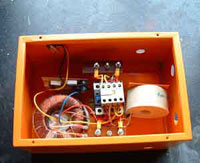
Reasons: If the control supply is derived from the secondary output of the welder, the contractor will drop out under full load condition because there is no supply voltage available when the welder (operator) short circuit the welder secondary. This will
damage the contractor which is only rated to break the load under non-welding conditions. The use of lead acid batteries complicates the circuit design because of having to use a battery charging circuit and complications of boiling the battery dry . A
fully rated contractor must be used, which imposes a very high cost.
|
| |
Gouging Application
The recommended open circuit voltage for DC gouging is plus 90 volts. This defeats
the purpose of using an open circuit reducing device. We consider gouging to be highly dangerous and probably against many regulations
|